Agiasos Reading Society
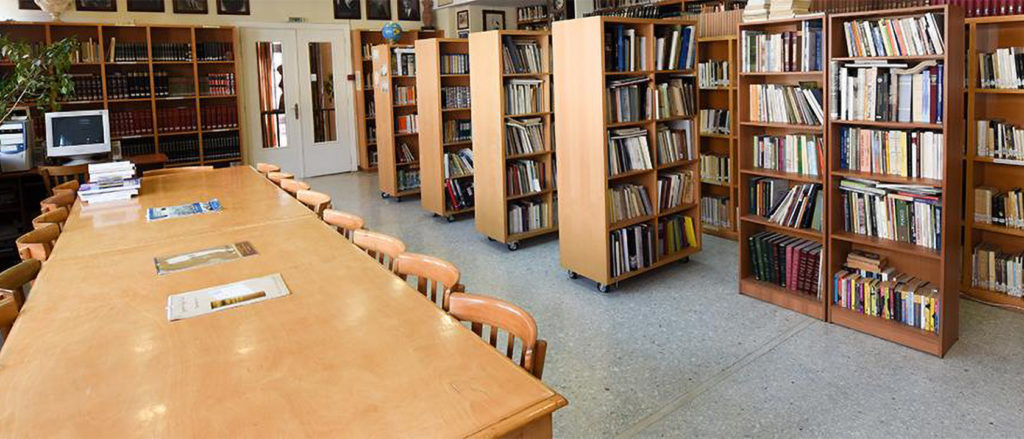
The Agiasos Reading Society (Anagnostirio), founded in 1894 during the Ottoman era and still carrying on its wide-ranging activities without interruption to this day, is the ark of Agiasos’s rich folk tradition.
The Carnival
Agiasos is the Mecca of the Lesvian carnival, drawing thousands of people every year to its events. The Agiasos carnival stands out for its uniqueness and is a rare example of local folk intellectual and artistic creativity. The roots of the custom are lost in the depths of the Ottoman period. Over the course of more than a century, the custom has gone through many stages, been shaped by countless circumstances and evolved alongside each successive historical era.
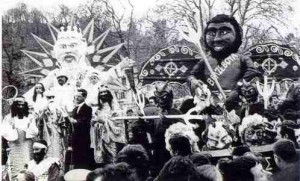
Yet the Agiasos carnival also stands apart from all other carnival events in Greece for its distinctive character: the biting, witty satire in verse (iambic fifteen-syllable lines), delivered in the local dialect by folk poets.
The oldest Carnival custom was the “patinada”, a procession of young men through the village neighbourhoods, where the “kouitoukia” (gathering rooms) operated and the “bride bazaar” took place. They sang old traditional songs (Sousa, Lygeri, Triantafyllenia, etc.).
Around 1900, the best singer of the group (the one who led the song) would dress in an evzone’s fustanella and helmet, portraying Alexander the Great, a symbol of the unconquered Greek spirit, and with his songs he lifted the national morale of the enslaved rayahs.
The Reading Society took an interest in the carnival as early as the Ottoman period. According to minute no. 56/27-2-1902 of its Board of Directors, a committee made up of Board members held a fundraiser to award cash prizes to carnival groups.
At the beginning of the 19th century, verse began to be introduced. At first, the village jesters put on small improvised performances, satirising people and situations of the local community.
After 1912, and even more so after 1922, new folk poets emerged. They were the battle-hardened young men of Agiasos who had returned from the war fronts. Through their satire, they voiced demands for peace, justice and social change, and established the Agiasos dialect as their means of expression.
As early as the pre-war period, the custom of the anti-carnival, or “carnival battle”, came to life.
In 1938 the Reading Society made use of a donation from Theodoros Ntougramatzis, or Koukouvalas, to establish the “Valeio” Competition (awarding cash prizes to competing carnival groups), which, with brief interruptions, lasted until 1984.
At the Carnival of 1944, the prophetic voice of the carnival rang out, foretelling the defeat of German fascism and the liberation of the homeland.
After the Civil War, the carnival took on new forms. The place and time of the events changed. The mule-drawn carnival gave way to floats, which became established in the years of Anania Karamanlis.
The carnival flourished especially during the dictatorship and the period of the restoration of democracy (Metapolitefsi), when many of the finest masterpieces in its history were presented, and indeed under conditions of strict censorship.
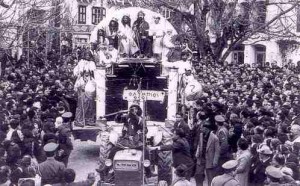
Today it retains the form it took after the war: a folk performance with strong theatrical elements in an open public space, combining satirical verse with the appearance of floats into a unified theme. The subjects of the folk muse cover a very wide range, drawn mainly from ancient Greek history and mythology, as well as from our religious tradition. Through them, today’s socio-political reality is portrayed allegorically and symbolically, and current figures and events are satirised through parallels. The people’s poet does not simply put on a mask to entertain the audience; he edifies, sets an example and, with the cauterising iron of his pen, burns away the rotten part of the social body. He is not prudish: he strikes mercilessly at what is wrong and speaks frankly and honestly. He is bold and prophetic. He does not fear, does not compromise and spares no one. With his caustic outspokenness, he administers injections to the ailing social organism.
Over the centuries, oral folk tradition has preserved the “tripsimata”, rhyming couplet songs that celebrate the genitals.
The carnival tradition continues to this day. Since 1984, the Agiasos Cultural Association “O SATYROS” has taken over responsibility for organising the carnival events. Since 1999, the two associations have worked together to organise research-based events reviving old carnival customs. From the same year, the Municipality of Agiasos has also taken part in organising the carnival events.
The Music and Dance Tradition
The musicians
A full traditional Agiasos band (kompania) consists of six instruments: violin, santouri, clarinet, trombone, bass and cornet. There are also individual musicians who play the zourna and davul. At the beginning of the century, around 1916–1917, the barrel organ (laterna) was introduced from Smyrna, while a little later came the mandolin and the guitar, for amateurs serenading their sweethearts. Many young women from well-to-do families also learned the mandolin. After the war the bouzouki arrived, taking the place of the santouri in the band.
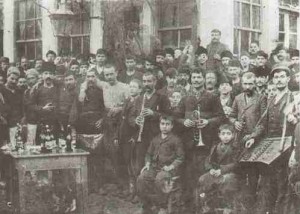
Musicians were hired by individuals either in advance for a wedding, christening, etc., or spontaneously in moments of high spirits, or on Sundays and holidays. On major holidays they were hired by the large coffee houses. The “Reading Society” hired them for its dances, and the guilds when they celebrated their patron saint.
Their fee was sometimes agreed in advance, usually with the large coffee houses, and was topped up by the “hartoura”, the money that groups of revellers tossed onto the santouri.
Musicians were in great demand and enjoyed great prestige, given the important place dance and music held in the lives of the people of Agiasos. From the moment they stepped out in the morning they had work, usually starting at the coffee houses in the market and often ending up at the home of the local who “had” the music, or the other way round. On feast days they didn’t sleep at all. The old musicians drank a lot, and some died alcoholics. The younger ones drank only a little, just to get into the mood, as they themselves say.
The tunes
The people of Agiasos do not sing while dancing. They sing table songs at weddings, engagements and christenings, or processional tunes played by the band in the Sunday patinada, or when accompanying the bride to church or the deceased to their final resting place, always, of course, with fitting content.
As for their origin, it is hard to distinguish Lesvian tunes from those of Asia Minor. Lesvos and the Asia Minor coast were considered one and the same; contact was constant and musicians often travelled from one side to the other. Well-known tunes included the zeibekiko of Aivali, the Smyrneiko and the Pergamino. The most popular tunes, however, regarded as the “national anthems” of Lesvos, are “Xyla”, a syrtos probably derived from a Turkish march, and “Kioroglou”, in 5/8 rhythm, played mainly at the feast of Profitis Ilias.
Alongside the local tunes, however, there are also European ones.
The dance repertoire falls into three categories:
The fixed sequence of dances
The music starts with a syrtos, moves on to the ballos, then to the karsilamas and the zeibekiko, and ends with the “mazomenos”, also called “pidichtos” or “anigkaskos”.
The syrtos, in 2/4 rhythm, was usually danced by two people, but also by more when spirits ran high. From the syrtos, the violin makes a turn, plays an amanes and moves on to the ballos, which is also danced by two people. Next comes the karsilamas, in 9/8 rhythm, a face-to-face dance for two. Then we move on to the zeibekiko, also in 9/8 rhythm, for two people or even “solo”.
Finally, the mazomenos or pidichtos is danced by many people at the height of the celebration, with leaps, like a fast syrtos. The order never changed; it was an unwritten rule. The kalamatianos was also often danced, mainly at village festivals (panigyria).
Interspersed dances
By this term we mean dances that were not part of the usual sequence and were not danced by everyone; although their rhythms were familiar, they had their own peculiarities, changed the atmosphere and broke the established order. These were:
The “tzamkos”, in 2/4 rhythm, a slow syrtos danced by two people, also known as the “knife dance”. One dancer held a knife, or tongs taken from the counter where the coffee was roasted, and pretended to threaten the other, who remained seated and impassive. The first dancer traced circles in the air with his knife and pretended to cut off the other’s nose, ears, head and genitals, each time throwing them to the onlookers with a sudden movement. Throughout the dance he repeated the same movements, drawing laughter from the audience. It was a mimetic dance performed only by certain people, when they were in high spirits or were urged on by the company. The dancer had the skill to perform extremely precise movements.
The “poutanikos” or “potirakia” (little glasses) was also a mimetic dance, performed by men impersonating women. They held small glasses in their hands, clinking them together, while the band accompanied them with only the violin, santouri and bass so that the sound of the glasses would not be lost. This dance seems to have come to Lesvos with soldiers who had gone to Asia Minor in 1922, and it is in fact nothing more than an imitation of the belly dance as it was performed in the “café-chantants” of Smyrna and Constantinople.
The “Arkoudiaris” (bear-tamer) or “Arapikos”, a dance both mimetic and comic, was performed by two people, one playing the main role while the other served as partner. In 2/4 rhythm, like a lively syrtos, the dancer made wild gestures, rolled his eyes, imitated a bear and leapt about. It was danced mainly at carnival, and for a time it was almost the exclusive preserve of a shepherd nicknamed “Maroula”.
Dances for special occasions
The “nyfiatikos” or “nyfkatos” (bridal dance) was danced by the bride’s friends before the wedding. After helping her dress, they formed a circle around her with arms crossed and sang verses suited to the occasion, improvising freely and leading the dance to the right.
The “tripsimata” were danced in a circle, syrtos-style, by young people in costume during the carnival days, as they sang daring lyrics full of innuendo. They would often sit on the ground, rubbing their behinds on the floor.
It should be added that from the beginning of the century, European dances were very popular in educated circles, mainly the polka, the mazurka and the waltz, which reached Agiasos via Smyrna (the Paris of the East) or through young people who had studied abroad. The vast majority, however, danced the local dances.
Occasions for dancing
The people of Agiasos danced on Sundays, at religious feasts, at carnival, at dances, at the “glitomata” celebrations marking the end of the olive harvest, at weddings, engagements and christenings, and spontaneously at any moment. The most common dance occasion, however, was the Sunday “patinada”, closely linked to the game of courtship and marriage.
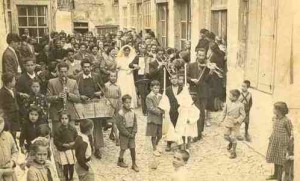
Young men, and older ones too, set out in groups from the coffee houses of the market, the centre of public life in Agiasos, and together with the band or individual musicians made their way through the village lanes, ending up at the so-called kouitoukia: small neighbourhood coffee houses that opened only on Sundays and holidays and served raki, cognac and roasted chickpeas.
In the neighbourhoods they could make contact with the young women, who waited in front of their houses for the music to arrive, seated on their “kariglia”, wearing their best breeches (vraka) and gold coins on their chests. Women, and young women in particular, rarely went down to the coffee houses of the market. They stayed in their neighbourhoods, embroidering, knitting and chatting, seated outside their front doors, away from the gaze of the men, who came up on Sundays to have fun and express their love by dancing at the kouitoukia, while the young women watched from a distance.
The band followed an order of precedence among the groups of friends, but misunderstandings were never lacking. Only men danced together. On the rare occasions when a husband invited his wife to dance, or a father his daughter, they were given pride of place. This does not mean that women did not dance. During the Sunday patinada they danced at the same time to the music played for the men, but among themselves, behind the houses so the men could not see them. They also liked to dance the kalamatianos.
The music at the kouitoukia lasted until morning and carried on with serenades beneath the girls’ windows. The custom of the patinada died out with the end of the war, when the last kouitouki closed.
The coffee houses and kouitoukia were also where the people of Agiasos danced at religious feasts, while at carnival dancing could break out anywhere and at any time, in a freer way. Organised dances, the preserve of the intelligentsia, were held in halls booked in advance, while at weddings, engagements and christenings people danced inside or outside the house, or even at the coffee house. The dancing was opened by the groom and the bride. Then they invited the best man (koumbaros) and the parents, and the celebration became general, with generous “hartoura” showered on the musicians. In the old days, two days after the wedding, once the bride’s virginity had been confirmed, a second celebration was held, the “antigamos”.
The olive-harvest “glitomata” also provided an occasion for dancing. From September almost until Easter, the village lived, and still lives, to the rhythm of the olive. The harvest began in November and peaked in January and February. On the last day of the harvest the women, at the landowner’s expense, prepared food and sweets, and once a few glasses of wine had lifted their spirits, they broke into dance, either on the estate or at Karini, a spot with plane trees where all the paths of the olive grove met. If the landowner was generous, he brought a band; otherwise they made do with the davul and zourna, or kept the rhythm themselves by beating on tin cans.
After a few hours they set off for the village, men and women together, arm in arm and singing, to continue the celebration in the village coffee houses. The dancing atmosphere at the glitomata seems to have been much freer, since men and women had worked side by side in the same place for months.
Dance etiquette
The style of dancing was measured and restrained. The people of Agiasos did not care for elaborate figures. Nor did they dance any dances other than their own, and they regarded the dancing of outsiders who came to the village with irony and disdain. Clashes were frequent with their fellow Greeks from Asia Minor, who, being wealthier, monopolised the dancing with their tips (bakshish).
The music and dance landscape of Agiasos changed gradually after World War II, especially from the early ’50s. Major socio-economic changes, emigration, new customs and the arrival of the gramophone and the radio altered the tradition.
Today the people of Agiasos still dance to old tunes and dances, but many new elements have crept in (accordion, bouzouki, synthesiser). Occasions for dancing have become fewer, mainly religious festivals and events held by various associations. Dancing is no longer an everyday practice.
Amateur Theatre
According to available information, amateur theatre performances in Agiasos began in the century before last. The first performance, of Dimitrios Vyzantios’s play “Babylonia”, was staged in 1879 by the association “Philoptochos Adelfotis Agiasou” (Charitable Brotherhood of Agiasos). Many others followed, and amateur theatre became a tradition that continues to this day.
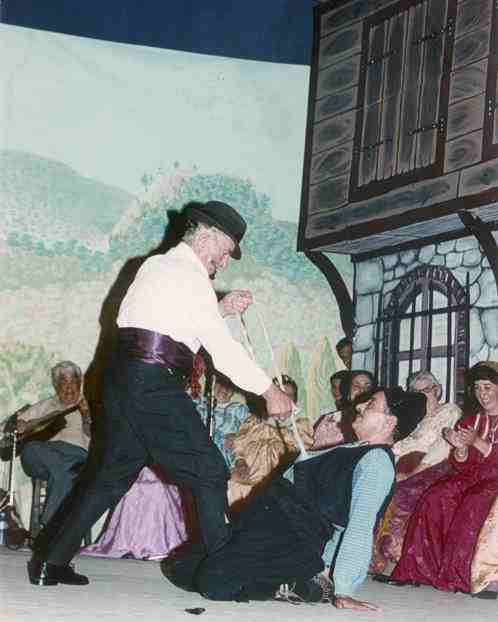
The Reading Society naturally adapted to the spirit and repertoire of each era, presenting idyllic dramas, tragedies with national themes, one-act comedies and the like.
After the island’s liberation, amateur theatre performances continued, and following the re-founding of the Reading Society many efforts were made to equip the theatre. The old sets, worn out through use, were replaced and the wardrobe was expanded. Several Greek and foreign plays were staged successfully.
In Agiasos, thanks to the dedicated efforts of Panos Pratsos and his collaborators, chiefly the teacher Christofas Chatzipanagiotis, who worked as director, and the ceramicist Charalambos Pantazis, who worked as set designer, the Reading Society’s amateur actors also staged operettas with outstanding success. As is well known, the operetta, that short comic musical drama, presents considerable challenges, because in addition to spoken dialogue there is music, dance and song, all of which require coordination. An actor, and even more so an amateur, must be talented to meet the demands of this genre. The Reading Society also staged several comedies with great success.
Early on, however, the people of Agiasos felt the need to write plays in their own local dialect, mostly portraying local life and manners. Since 1994 the Reading Society has also staged Lesvian revues written in the Agiasos dialect by Antonis Minas.
Its theatrical activities have brought forward hundreds of amateur actors and, most importantly, dozens of playwrights, writers and satirists, some of whom gained nationwide recognition and were even honoured with a literary pension.
Today there is an adult amateur theatre group for plays of local life and Lesvian revues, as well as an Experimental Stage for children and adults.